
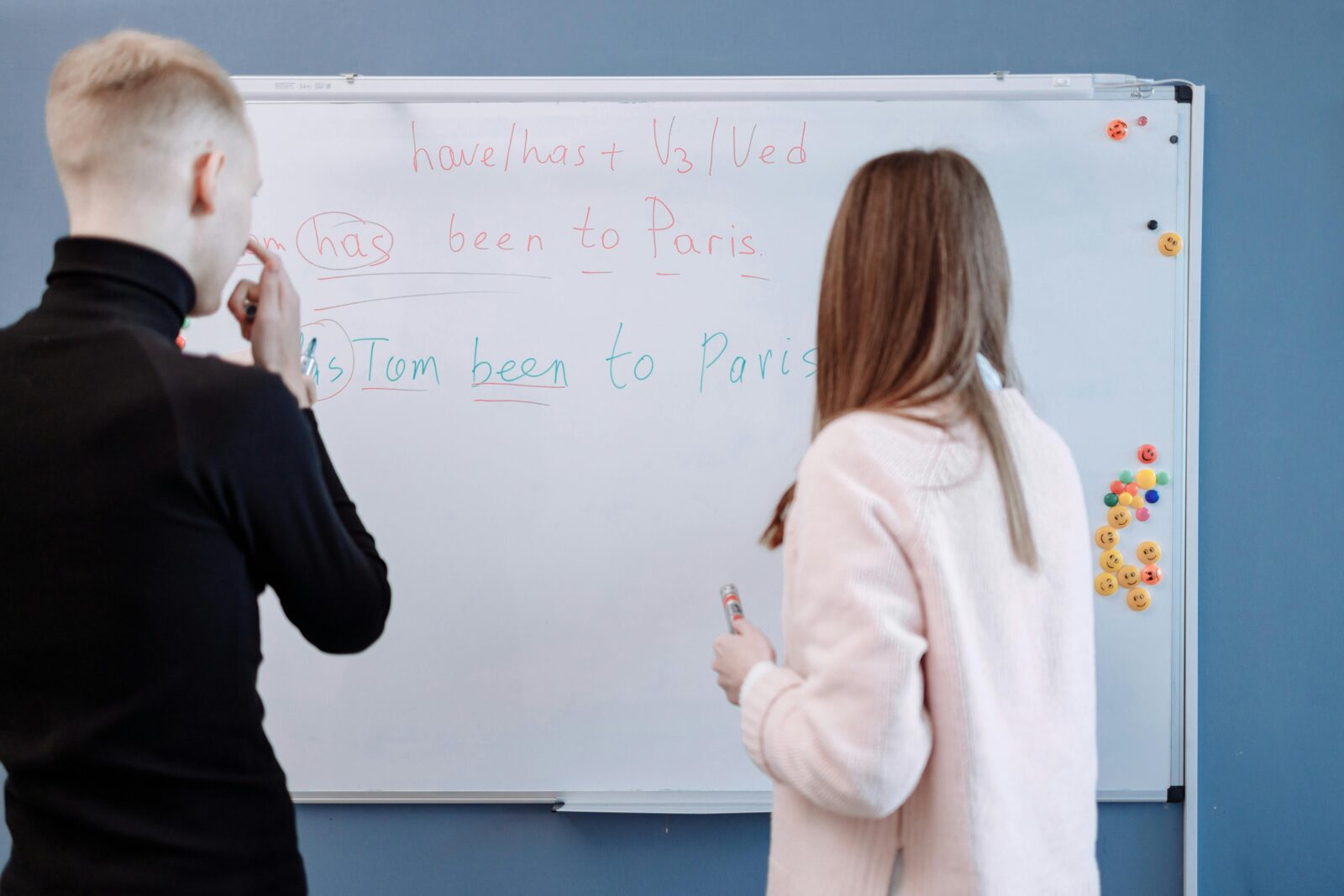

Ask most parents what they want from an English preschool in Warsaw, and the answer is usually some version of the same thing: a child who speaks English naturally, without effort, without an accent, and without the anxiety that tends to accompany language learning later in life. What many parents are less certain about is how a preschool actually delivers that outcome – and why some bilingual programmes produce genuinely fluent children while others produce children who know a handful of songs and some colours. The difference lies almost entirely in methodology. Specifically: how much of the child’s day is spent in authentic English immersion, as opposed to English lessons.
Immersion vs. instruction – why the distinction matters
In a standard language programme, a child attends Polish-language kindergarten and receives English “lessons” – typically 30 to 60 minutes a day of structured activities with a teacher. This approach produces limited results for one straightforward reason: children do not acquire languages through instruction. They acquire them through use.
Language acquisition in young children happens when they need language to do things – to ask for something, to play with a friend, to understand a story, to follow an instruction, to express a feeling. The moment language becomes a means to an end rather than a subject of study, acquisition accelerates dramatically.
A genuine English-language or bilingual preschool structures the entire day around this principle. English is not a lesson that takes place at 10 am. It is the language in which morning circle happens, in which the educator explains the day’s activities, in which stories are told, arguments are mediated, and jokes are made. A child in this environment is not learning English. They are living in it.
What a well-structured bilingual day looks like
The structure of a quality bilingual preschool day reflects a careful balance between the two languages and between structured and free learning time. A typical rhythm might look like this:
Morning welcome and circle time – conducted in English. Songs, discussion of the day’s theme, weather, calendar. This is often the most language-rich part of the day for young children because it is highly routinised – the same phrases, questions, and responses appear every morning, giving children the repetition they need to internalise structure.
Activity blocks – alternating between English and Polish across the week, often with language tied to subject matter. Science and STEAM activities may run in English; movement and art in whichever language feels most natural to the educator leading them.
Play time – partly free, partly guided. Children interact with peers in whatever language comes naturally. Mixed-nationality groups are particularly valuable here: a child who wants to play with a Polish friend will instinctively reach for Polish words; one who wants to connect with an English-speaking peer finds English.
Story time and read-alouds – a critical language-development activity that is often underestimated. A skilled educator reading aloud in English, with expression, pauses for questions, and discussion, provides children with vocabulary, syntax, and storytelling structure that transfers directly to their own language use.
Specialist activities – karate, robotics, swimming, music, dance – often conducted by a specialist educator and representing a natural opportunity for content-based language immersion. A child focused on building a Lego structure or practising a swimming kick is not thinking about language – they are using it.
The role of the native-speaker educator
The presence of at least one English-speaking educator in every group is the structural backbone of any genuine bilingual programme. Not a weekly visiting teacher. A permanent, daily presence.
Children are extraordinarily good at detecting authenticity. They know instinctively whether an adult is communicating in their natural language or performing in a second one. An educator whose English is their mother tongue brings not just vocabulary and grammar, but the natural hesitations, idioms, emotional expressiveness, and humour of a real speaker. This is what children unconsciously model.
A strong bilingual preschool ensures that from the very first day, each child has a consistent relationship with an English-speaking adult – someone they associate with safety, play, and warmth, as much as with language.
What happens at age six – continuity into international schools
For many families in Warsaw, particularly those on multi-year international contracts, the preschool years are a preparation for primary school – and often for an international school where English is the sole or primary medium of instruction. The transition from a bilingual preschool to an English-medium primary is seamless for children who have spent two or three years in genuine immersion. For children who have had only supplementary English lessons, it is frequently a significant adjustment.
Warsaw’s international primary schools – the American School of Warsaw, the British School, the French-German Lycée, and others – have consistently observed this pattern. Children arriving from immersive bilingual preschools integrate into English-medium classrooms quickly; children arriving with lesson-based exposure often struggle through the first year.
For parents planning ahead, this continuity is one of the most concrete arguments for prioritising a preschool with a robust, full-day English immersion programme from the start.
Cambridge certification from preschool age
A further measure of programme quality is whether a preschool’s English curriculum aligns with internationally recognised certification frameworks. The Young Learners English (YLE) programme, developed by Cambridge University Press in partnership with the British Council, provides a structured progression for children from the earliest stages of English acquisition through to a level appropriate for entry into international primary schools.
A preschool whose curriculum is designed to prepare children for YLE assessment is, by definition, working to external standards – not simply delivering English activities. For parents who may relocate again and need to demonstrate their child’s English level to a school in another country, this kind of documented progression has practical value.
English preschool Warsaw – TEQUESTA
English preschool Warsaw –TEQUESTA International Preschool & Daycare has been running bilingual Polish-English education in Warsaw since 2008, with three locations: Mokotów (ul. Przejazd 2, Marina Mokotów), Żoliborz, and Białołęka. Children are accepted from age one. Every group has two educators, one of whom is an English speaker. TEQUESTA’s own English language programme is accredited by the British Council and Cambridge University Press and prepares children for YLE certification.