
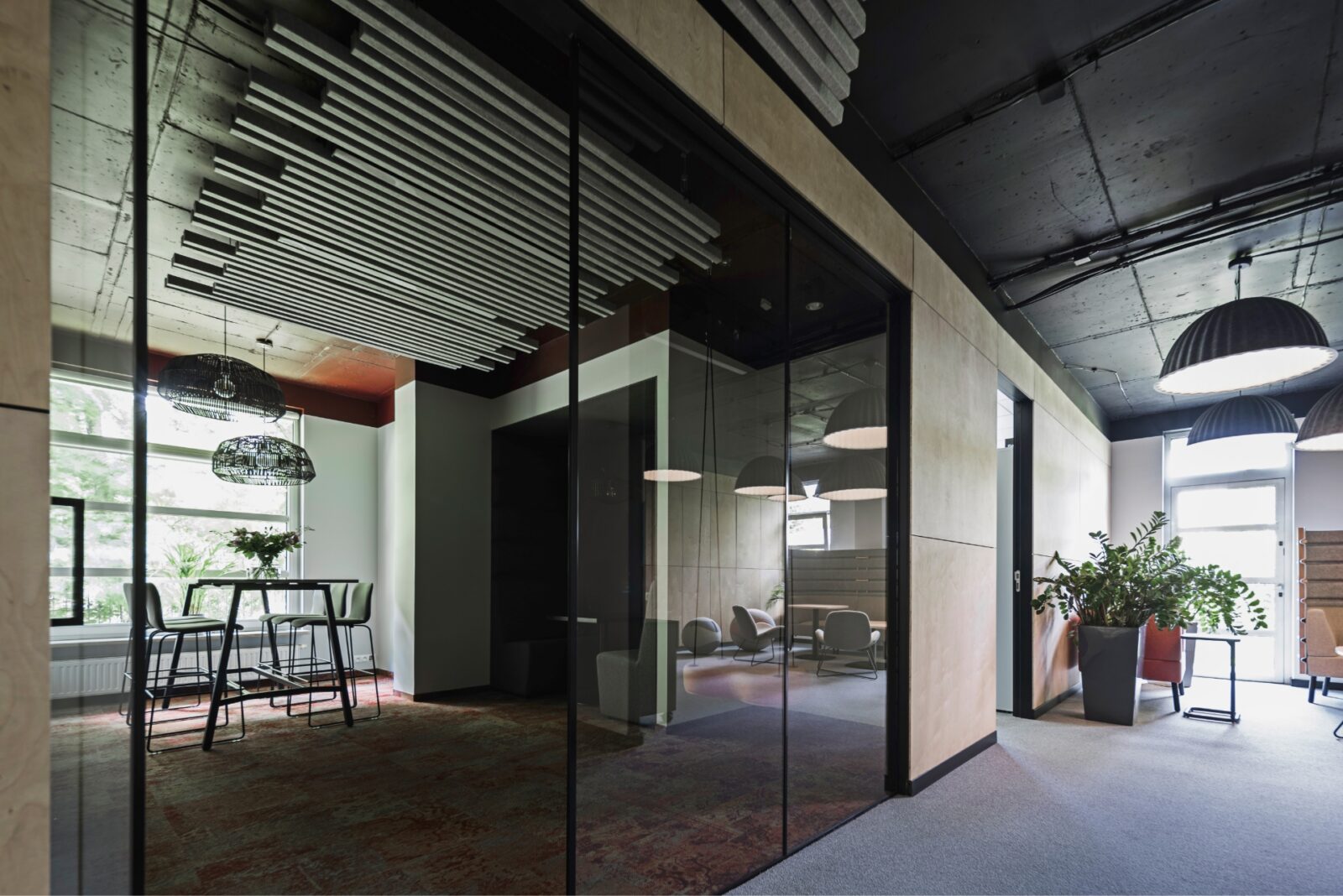

Signing a lease on an office space in Warsaw is the beginning of the project, not the end of the decision-making. What happens next – the fit out – is where the abstract idea of “our new office” becomes a physical reality that hundreds of people will work in every day. Get it right and the space supports productivity, reflects company culture, and holds its quality for years. Get it wrong and you spend the next lease term fixing it.
What a Fit Out Actually Is – and What It Isn’t
The term fit out is used loosely in the market, which causes confusion. In the Warsaw commercial real estate context, buildings are typically handed over as shell and core – with base structure, facade, and core MEP risers, but nothing else – or with a basic cat-A finish that includes raised floors and suspended ceilings but no partitions, lighting, or data infrastructure. A fit out is the full transformation of that raw space into a working office.
This is not an interior design project with some construction work attached. It is a multi-disciplinary construction and engineering undertaking, coordinated across architecture, structural work, HVAC, electrical, IT, and furniture – all delivered within a fixed budget and a non-negotiable handover date. The design component is essential, but it is one part of a considerably larger whole.
The Full Scope of a Warsaw Office Fit Out
What a comprehensive fit out covers in practice depends on the starting condition of the space and the ambitions of the client. A full-scope engagement typically includes:
- Space planning – developing a layout that balances team adjacencies, circulation, meeting and focus spaces, and compliance with Polish H&S and building regulations
- Architectural and interior design – translating brand identity into a built environment through material, finish, colour, and lighting specifications
- Partition walls – construction of new demising walls, installation of glazed partitions, acoustic and fire-rated assemblies
- Ceilings – suspended ceiling systems, acoustic baffles, exposed concrete or feature ceiling treatments depending on the design concept
- Flooring – carpet tiles, LVT, raised access floors, polished concrete, or combinations by zone
- Mechanical and electrical – HVAC adaptation or full fresh-air system installation, lighting design and installation, power distribution, data cabling and IT infrastructure
- Furniture – workstations, storage, meeting and collaboration furniture, reception, breakout, and kitchen areas, specified and installed as part of the overall design
- Project management and handover – coordination of all trades, programme and budget control, building authority approvals, and final commissioning
Managing this scope in parallel – under time pressure, inside an occupied building or a live development – is what separates capable fit out contractors from the rest.
Warsaw’s Specific Challenges
The Polish capital adds its own complexity to what is already a demanding project type. The city’s office stock is unusually diverse: a 1970s office block in Mokotów, a refurbished pre-war building in the city centre, and a brand-new tower in Wola each present entirely different technical conditions. Slab heights, structural grids, existing MEP quality, and the general condition of what is behind the walls all vary enormously.
Experienced local contractors bring institutional knowledge that no due diligence document fully captures. Knowing which buildings have reliable existing infrastructure and which require a full strip-out before fit out work can begin changes the budget conversation significantly. So does familiarity with Warsaw’s building permit process and the timelines involved in getting Sanepid and health and safety approvals – both of which are mandatory at specific stages of an office fit out.
The Tenant’s Perspective: Managing Risk and Budget
For tenants, the fit out is often the largest capital expenditure associated with an office move – frequently exceeding the cost of several months’ rent. The financial stakes are high enough that how you manage the process matters as much as what you decide to build.
A few principles consistently separate successful projects from troubled ones. Engaging the fit out contractor early – ideally before the lease is signed – allows technical input to inform the space selection decision, not just the space execution. A contractor who has visited the shortlisted buildings can flag structural issues, ceiling height constraints, or MEP limitations that affect both the design possibilities and the budget, before any commitments are made.
Negotiating tenant improvement allowances with the landlord is also significantly easier when you have a credible, detailed cost estimate rather than a rough budget based on price-per-square-metre rules of thumb. Landlords negotiate against real numbers, and a fit out partner with a strong track record in Warsaw carries credibility in those conversations.
What to Look for in a Fit Out Contractor
The Warsaw fit out market includes firms of very different sizes and capabilities. At one end, large international contractors who prioritise volume and standardised processes. At the other, smaller local operators with deep building knowledge but limited capacity for complex, multi-disciplinary projects. The most capable partners combine local market expertise with genuine engineering depth across all the disciplines a full fit out requires.
References from completed projects for comparable tenants – in terms of scale, sector, and quality expectations – are the most reliable indicator of fit. The Warsaw market is small enough that reputation travels, and the firms that consistently deliver on programme and budget tend to be known. Ask to speak directly with previous clients before signing any contract. The conversation will tell you more than any tender document.